
Artificial intelligence is reshaping every global sector, but no industry feels its impact more deeply than energy. AI development requires massive amounts of electricity, while AI tools offer new solutions for grid efficiency, renewable management, and decarbonization.
This blog distills the most important findings from the IEA’s 2024 report on AI and energy, highlighting trends, risks, and opportunities that every policymaker, engineer, and sustainability professional must understand.
The Rise of AI and Its Energy Demands
AI has evolved from a research topic into a multitrillion-dollar industry. Since 2014, the computational requirements for training advanced AI models have increased 350,000×, driving exponential demand for electricity and digital infrastructure.
Key facts from the report:
AI-related companies drove $12 trillion of the $16 trillion S&P 500 increase since 2022.
Data-center investments doubled to $0.5 trillion in 2024.
Data centers now consume 1.5% of global electricity (≈415 TWh), expected to double by 2030.
Around 20% of planned data centers risk delay due to grid constraints.
In short: there is no AI without energy, and current energy systems are already under pressure.
Understanding AI Types and Global Supply Chains
The IEA classifies AI into:
Predictive AI (forecasting, predictive maintenance, e.g., AlphaFold)
Generative AI (language models, multimodal models, reasoning models)
Physical AI (robots, drones, autonomous systems)
Agentic AI (autonomous energy-management systems, workflow agents)
The AI supply chain spans:
Data centers (US, EU, China dominate)
GPUs & TPUs
Chip manufacturing (TSMC holds ~65% global market share)
Critical minerals & fabrication equipment
This supply chain creates geopolitical dependencies with significant implications for global energy planning.
Global Data Center Distribution and the Digital Divide
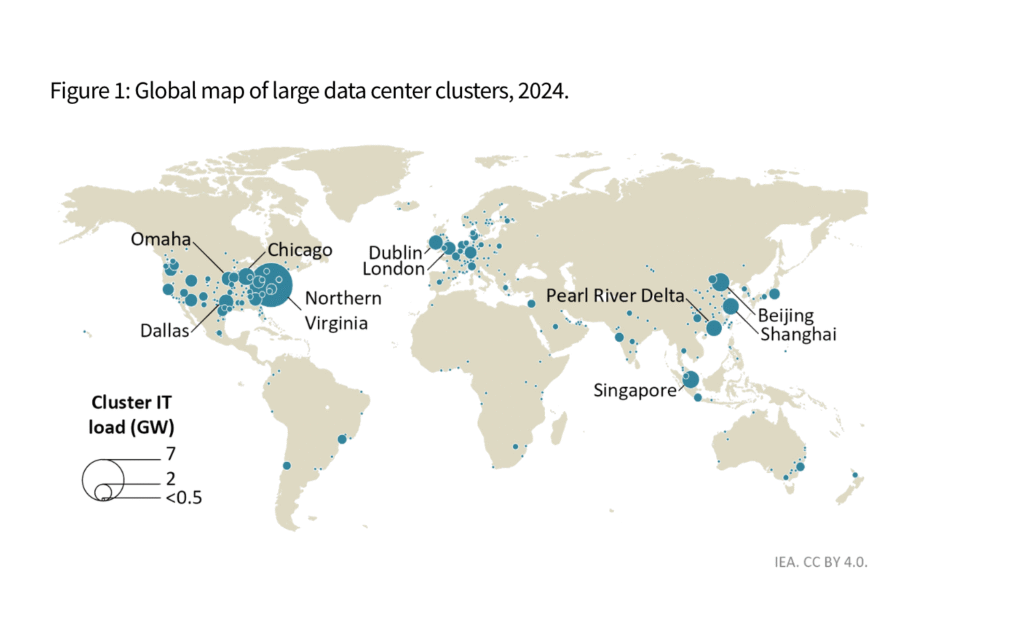
AI’s infrastructure is unevenly distributed globally;
Large data-center clusters exist in the US, Northern Europe, and East Asia. While Africa, South America, and the Middle East lag significantly. This contributes to a global digital divide, limiting AI deployment in developing countries.
Data centers that are often located in urban or strategic economic zones are already straining local grids, increasing the urgency for regional energy upgrades.
Electricity Demand: Data Centers, AI Training, and Digital Infrastructure
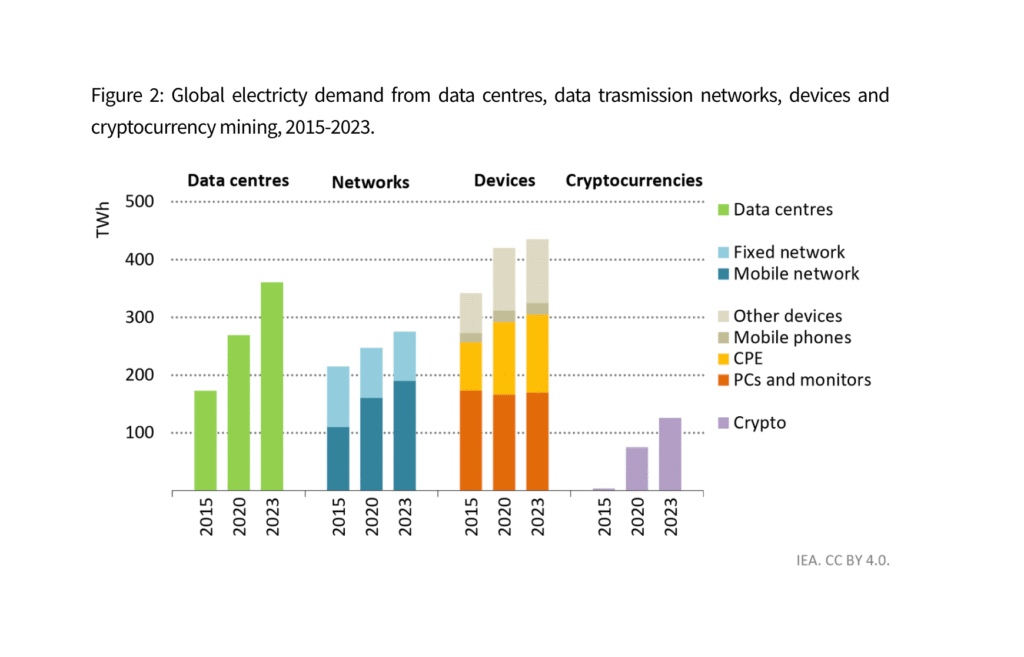
The growing electricity demand from AI training, data transmission networks, and cryptocurrency mining presents major challenges.
The report highlights:
-
The largest AI model today requires 154 MW at peak and up to 300 GWh per training cycle.
-
Combined training for top models exceeds 1,700 GWh, including estimated and extrapolated data.
-
Demand from data centers, networks, and devices has risen sharply since 2015.
Meeting this growth sustainably requires a decisive shift toward low-carbon and dispatchable energy sources. The IEA emphasizes that simply expanding renewable energy in parallel with fossil fuels is insufficient; renewable growth must outpace demand growth to avoid locking in continued dependence on high-emission sources. Effective decarbonization including expanded geothermal, hydropower, nuclear restarts, grid-flexibility measures, and storage solutions is essential to ensure AI’s energy footprint evolves without undermining global climate goals.